General research interest:
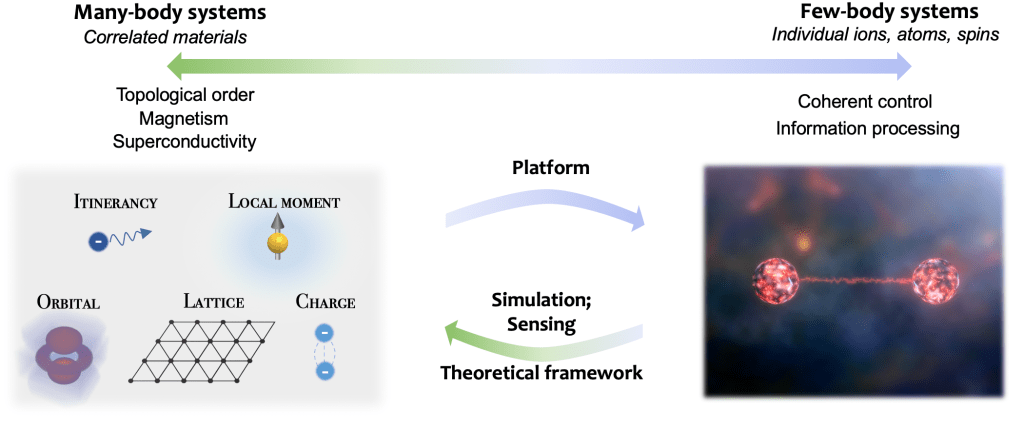
The laws of the physical world are written in ℏ, but its manifestation can often be obscure. We are interested in using and developing scanned probe methods to unveil and control non-classical physics in two regimes:
1. Individual atoms, spins, electrons. Traditionally investigated by the AMO community, these isolated degrees of freedom are ideal for demonstrating coherent control and building larger artificial systems. In solid-state environments, a myriad of spin species and other microscopic discrete-level objects have been identified, but a general local probe that can access and address these individual objects has been lacking until recently (see Project 1 below). Combined with the capability of constructing atomically precise structures via atom manipulation, this endeavor may open up room for imagining how a large Hilbert space can be realized in the tiniest area.
2. Many-body states of matter. A macroscopic number of electrons or spins can act collectively to form states of matter where non-classical effects prevail. Many electrons, for example, can act coherently to form condensates such as superconductivity. Many spins can form unconventional magnetic states such as spin liquids (see Project 2 below) or exhibit macroscopic tunneling and coherence effects. We hope to leverage coherent probes and new material systems to provide a fresh perspective to these important topics.
Current projects include:
Atomic-scale coherent control
In this direction, we are interested in objects that are minute –– single charge, spin, orbital, and vibrational modes –– yet can be determined very precisely for use as probes, information storage, or building blocks for bigger artificial systems. We access these degrees of freedom, often embodied in single atoms/molecules but also in solids, by scanned probe microscopy and manipulate them using electromagnetic wave-based coherent control methods.
A groundbreaking work along these lines was the coherent control of a single spin inside the tunnel junction of a scanning tunneling microscope [1, 2]. Recently, we managed to push beyond this limitation by controlling and detecting multiple spins outside the tunnel junction, a task that seemingly violates the basic principle of STM [3]. This, for example, allows us to perform fast controlled-controlled operations at the atomic scale [3].
Interesting future directions include the extension of coherent control techniques to other discrete-level systems and the identification of new material systems with reduced decoherence/relaxation.
[1] “Electron paramagnetic resonance of individual atoms on a surface”. S. Baumann, W. Paul, T. Choi, C. P. Lutz, A. Ardavan, A. J. Heinrich. Science 350, 417 (2015)
[2] “Coherent spin manipulation of individual atoms on a surface”. K. Yang, W. Paul, S.-H. Phark, P. Willke, Y. Bae, T. Choi, T. Esat, A. Ardavan, A. J. Heinrich, C. P. Lutz. Science 366, 509 (2019)
[3] Y. Wang, Y. Chen, H. T. Bui, C. Wolf, M. Haze, C. Mier, J. Kim, D.-j. Choi, C. P. Lutz, Y. Bae, S.-h. Phark, A. J. Heinrich. arXiv: 2108.09880
Exotic phases in 2D materials
In this direction, we are interested in exotic phases realizable in a variety of 2D systems, enabled by recent developments in material fabrication.
We have recently used scanning tunneling microscopy (STM) to probe a newly identified 2D spin liquid candidate, single-layer 1T-TaSe2, where the development of a charge density wave leads to a flat-band formation, akin to bandwidth reduction in Moire superlattices. To fulfill the prerequisites of spin liquids, we first established single-layer 1T-TaSe2 as a triangular-lattice Mott insulator hosting local moments [1]. It was predicted that this kind of U(1) spin liquids can be understood as an exotic “neutral metal”, containing a Fermi sea of itinerant, chargeless spinons in an electronic insulator [2]. Evidence of itinerant spinons was first provided by surprising long-wavelength spatial modulations of single-layer 1T-TaSe2. Fourier transforms of STM spectroscopic images show good agreement with a Fermi-surface instability in a half-filled spinon Fermi surface [3]. The second piece of evidence was provided by Kondo screening from itinerant spinons (in an insulator!). This effect was induced by depositing magnetic impurities onto single-layer 1T-TaSe2 and detected by unique signatures of spinon Kondo resonance [4].
Interesting future directions include probing new layered correlated insulators that have been traditionally inaccessible to STM, spin-sensitive imaging of 2D twisted systems, and using spin sensors to detect the underlying states of matter.
[1] “Strong correlations and orbital texture in single-layer 1T-TaSe2”. Y. Chen, W. Ruan, M. Wu, S. Tang, H. Ryu, H.-Z. Tsai, R. L. Lee, S. Kahn, F. Liou, C. Jia, O. R. Albertini, H. Xiong, T. Jia, Z. Liu, J. A. Sobota, A. Y. Liu, J. E. Moore, Z.-X. Shen, S. G. Louie, S.-K. Mo, M. F. Crommie. Nature Physics 16, 218 (2020).
[2] “Spinon Fermi Surface in a Cluster Mott Insulator Model on a Triangular Lattice and Possible Application to 1T-TaS2”. W.-Y. He, X. Y. Xu, G. Chen, K. T. Law, and P. A. Lee. PRL 121, 046401 (2018).
[3] “Evidence for quantum spin liquid behaviour in single-layer 1T-TaSe2 from scanning tunnelling microscopy”. W. Ruan, Y. Chen, S. Tang, J. Hwang, H.-Z. Tsai, R. L. Lee, M. Wu, H. Ryu, S. Kahn, F. Liou, C. Jia, A. Aikawa, C. Hwang, F. Wang, Y. Choi, S. G. Louie, P. A. Lee, Z.-X. Shen, S.-K. Mo, M. F. Crommie. Nature Physics 17, 1154 (2021).
[4] “Evidence for a spinon Kondo effect in cobalt atoms on single-layer 1T-TaSe2”. Y. Chen, W.-Y. He, W. Ruan, J. Hwang, S. Tang, R. L. Lee, M. Wu, T. Zhu, C. Zhang, H. Ryu, F. Wang, S. G. Louie, Z.-X. Shen, S.-K. Mo, P. A. Lee, M. F. Crommie. Nature Physics 18, 1335 (2022).
 chenlab.science